
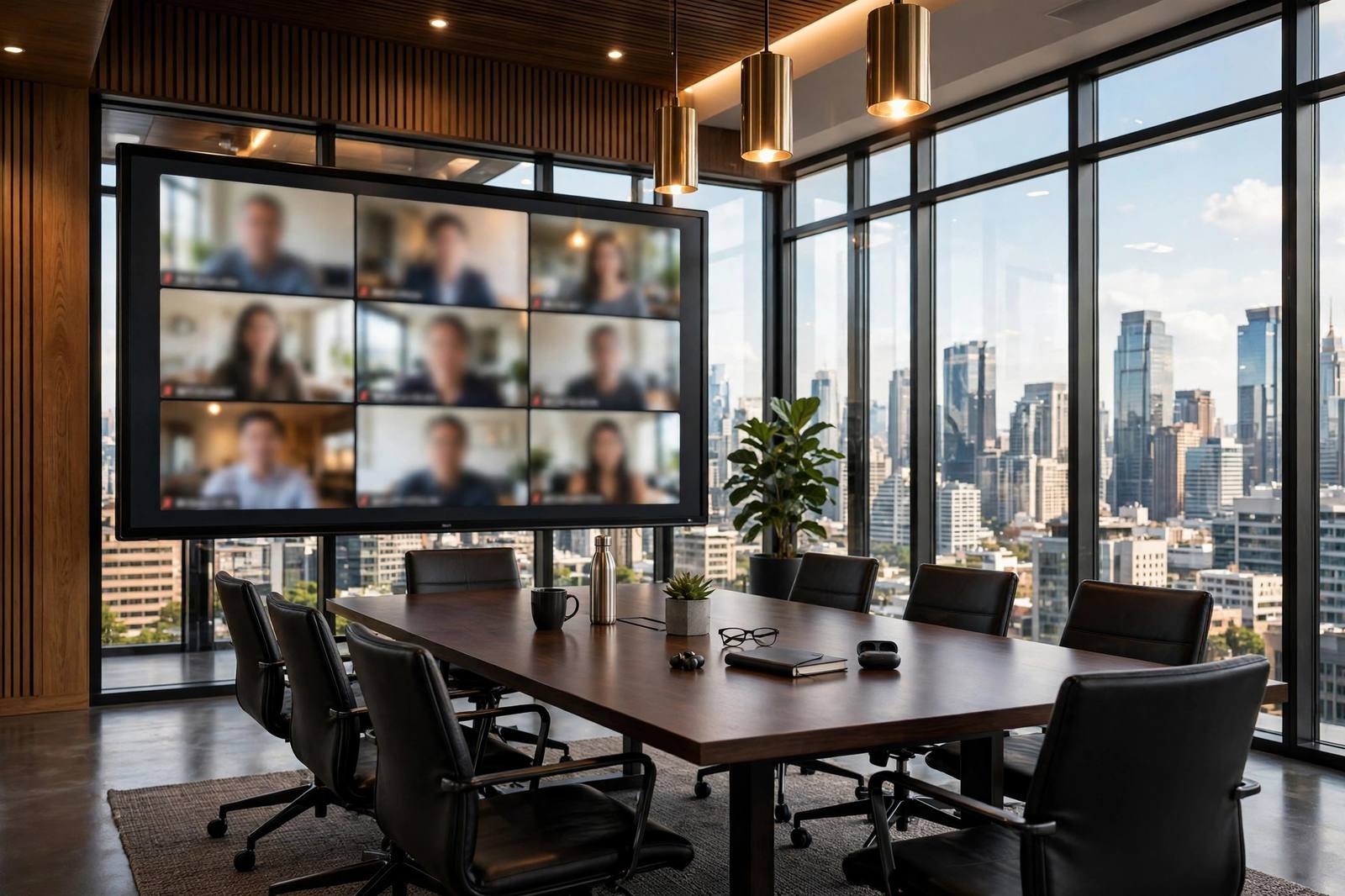
You know the room. Everyone in it can hear each other fine, yet the people on the video call keep asking everyone to repeat themselves and voices sound hollow and distant. The camera is good, the internet is fast, and the microphone was not cheap — so why does the room sound bad? In most offices, the answer is not the equipment. It is the room itself.
Why meeting rooms sound bad
Sound bounces off hard surfaces, and modern meeting rooms are full of them — glass walls, large tables, whiteboards and bare floors. When someone speaks, the microphone picks up their voice twice: once directly, and again a fraction of a second later as reflections off the walls, ceiling and table. That smeared, echoey sound is what the far end hears, and it makes speech harder to follow even when the volume is fine.
Parallel glass walls bounce sound back and forth between them, high hard ceilings add a long tail of reflections, and background noise — air conditioning, corridor chatter through a door gap — competes with voices for the microphone's attention. A room built to look bright and open is often, acoustically, a hard box.
Tell the three problems apart
Each problem has a different cure:
- Echo and reverberation: voices sound hollow or "bathroom-like", and the far end hears a tail after every sentence. This is reflections, and it is the most common problem.
- Background noise: a constant hum, hiss or murmur underneath every call. Air conditioning outlets, a noisy projector fan or corridor noise are usual suspects.
- Uneven pickup: the person nearest the microphone sounds loud while someone at the far end of the table is barely audible. This is a microphone coverage problem, not an echo problem.
Most bad-sounding rooms suffer mainly from echo — which is also the most fixable problem without rebuilding the room.
Diagnose it in five minutes
Before spending anything, clap once sharply in the middle of the room: a short, dry clap means the room is fairly well behaved, while a clap that rings afterwards means reflections are your problem. Then make a test call with someone speaking from each seat in turn, and sit in silence for a minute — the hum you stop noticing is exactly what the microphone hears all day.
Fixes that actually work
Acoustic treatment is about absorbing reflections. You do not need a recording studio — just enough soft, sound-absorbing surface to break them up:
- Start with what is already there. Curtains or blinds on glass walls, a rug or carpet under the table, and upholstered chairs instead of hard plastic all absorb sound — and they are the cheapest fixes available.
- Add acoustic wall panels. Fabric-wrapped panels on one or two walls — especially behind the main speaker positions — cut reflections dramatically. You do not need to cover every wall.
- Treat the ceiling. In glass rooms, the ceiling is often the largest untreated hard surface; acoustic tiles or suspended baffles above the table catch reflections wall panels miss.
- Seal the door. A gap under the door lets corridor noise straight in; a simple drop seal or brush strip has an outsized effect.
Where technology helps — and where it cannot
Good audio equipment matters, but it cannot fully rescue a bad room. Microphone placement is the biggest lever: a microphone in the middle of the table hears everyone far better than one built into a display at the far end of the room, and ceiling microphones work best above the table rather than above the door. For larger rooms, additional microphones matched to the table length beat turning up a single unit.
Echo cancellation and noise suppression in modern conference bars do a real job cleaning up what remains — but only up to a point, beyond which voices start sounding clipped and unnatural. Treat the room first, then let the technology handle what is left. Buying a more expensive microphone bar for an untreated glass box is the most common money wasted on meeting rooms.
Two mistakes are worth avoiding: covering one wall entirely while ignoring the rest — reflections simply find the untreated surfaces — and confusing soundproofing with acoustic treatment. Heavy doors keep noise out; panels and soft surfaces make the inside sound better. You usually need treatment, not soundproofing. Verify with a real call from every seat.
When to bring in a professional
Most small rooms can be fixed with the steps above. Bring in a specialist when the room is large, heavily glazed or used for board-level and client meetings, or when several rooms need to behave consistently. A proper survey places treatment where it will do the most good and matches microphones, speakers and displays to the finished acoustics — so the room is designed as one system rather than a collection of purchases.
Fix the reflections, quiet the background noise, and put the microphones where the people are, and the equipment you already own will finally sound like it should.
Request a quote, call us on (04) 359 4874, or message us on WhatsApp at +971 52 562 1946 for a free site survey — we will assess your meeting rooms, recommend the acoustic treatment and AV setup that fits each room, and install and test the complete system.